Action Functional
Lagrangian
L = 𝑇 − 𝑉 = L ( 𝑞 , ˙ 𝑞 , 𝑡 )
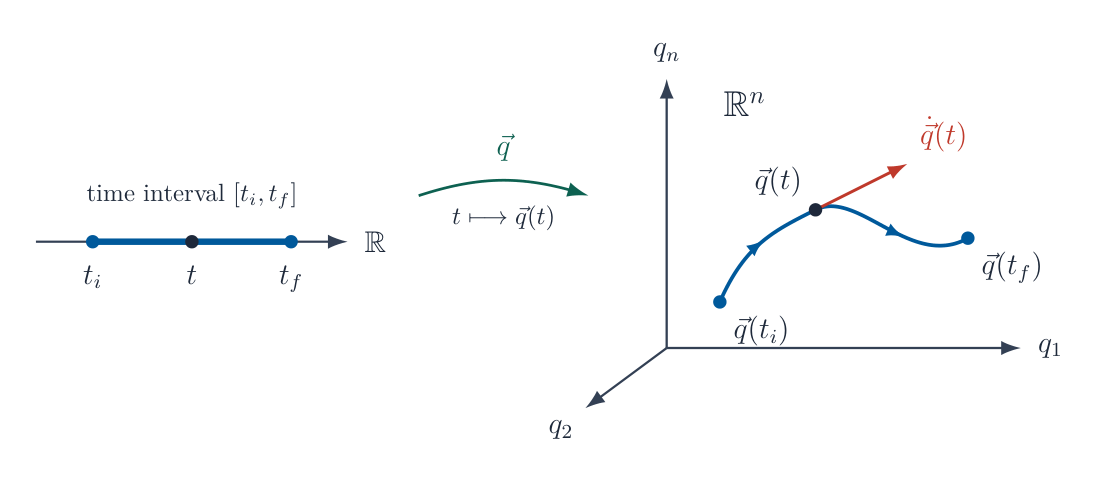
path
A path is mathematically defined as
⃗ 𝑞 ( 𝑡 ) ∶ [ 𝑡 𝑖 , 𝑡 𝑓 ] → ℝ 𝑛
The Principle of Least Action
Action Functional:
𝑆 [ 𝒒 ( 𝑡 ) ] ∶ = ∫ 𝑡 𝑓 𝑡 𝑖 L ( 𝒒 , ˙ 𝒒 , 𝑡 ) d 𝑡 Principle of Least Action: Often though not always, the action is minimized for classical trajectories, then this is the least action.
Euler-Lagrange Equation
Euler-Lagrange Equation
If
is the real path, then it obtains 𝒒 ( 𝑡 ) d d 𝑡 ( 𝜕 L 𝜕 ˙ 𝑞 𝛼 ) = 𝜕 L 𝜕 𝑞 𝛼
Proof.
Let
Since the endpoints are fixed,
Since the variations
Gauge Invariance
Actually, the lagrangian is defined up to a total time derivative, meaning
L ′ = L + d d 𝑡 𝐹 ( 𝒒 , ˙ 𝒒 , 𝑡 ) yields the same equations of motion. This is called gauge invariance.
Proof.
Consider the action
Taking the variation of the total-derivative term yields
Since the endpoints are fixed,